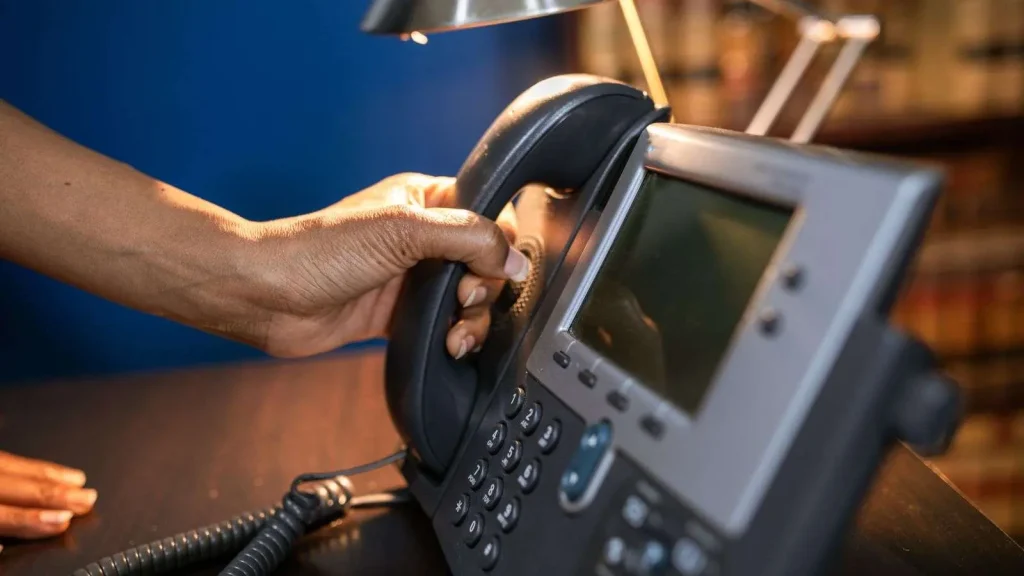
Imagine an employee collapsing in the break room on the third floor of your building. A coworker grabs the nearest desk phone and dials 911. Help is dispatched immediately — to a corporate headquarters address three states away, because that is the location still registered against your phone system. The ambulance is moving, but it is moving to the wrong place, and every minute it spends there is a minute your colleague does not have.
This is not a hypothetical scenario invented to sell you something. It is a live risk inside a surprising number of businesses running cloud-based phone systems, and it almost always traces back to the same root cause: enhanced 911 (E911) was configured once, at installation, and never verified again. The encouraging news is that closing this gap is far less complicated than most business owners assume. It requires a deliberate testing routine, a clear understanding of what the law expects of you, and a communications partner who treats emergency calling as a core function rather than an afterthought.
At Cytranet, emergency call routing and dispatchable location accuracy are built into the voice platforms we design, deliver, and support for more than 1,000 businesses, nonprofits, and government agencies. This guide walks through why E911 testing is non-negotiable, what the regulations actually require, and exactly how to run a test on your own system.
Why Cloud Phone Systems Changed the Emergency Calling Equation
A traditional copper landline had one job when it came to emergencies: tie a phone number to a fixed street address. The wire ran to a building, the building had an address, and that address sat in a database. It was rigid, but it was reliable.
Modern business communications broke that assumption on purpose. Today an employee may place a call from a desk phone in the main office, a softphone on a laptop in a hotel room, a mobile application on a personal device, or a home office two time zones away — all using the same extension, all riding the same cloud voice platform. That mobility is precisely what makes unified communications valuable. It is also precisely what makes emergency location data fragile.
If your system does not know where a device physically is at the moment 911 is dialed, it will fall back on whatever address it has on file. A misrouted emergency call does not merely delay assistance; it can send first responders to an entirely different building while the actual emergency continues to unfold.
What the Law Actually Requires: Kari’s Law and the RAY BAUM’S Act
Two federal statutes govern how multi-line telephone systems must handle 911 calls, and both apply to the vast majority of American businesses.
Kari’s Law
Kari’s Law requires that any multi-line telephone system allow a caller to reach 911 by dialing those three digits directly — no prefix, no “dial 9 first,” no exceptions. It further requires that the system automatically send a notification to a designated on-site party, such as a front desk attendant, security officer, or facilities manager, whenever a 911 call is placed. The intent is straightforward: someone inside the building should know that an emergency call has been made, so they can meet responders at the door and guide them to the right place.
The RAY BAUM’S Act
The RAY BAUM’S Act goes a step further, requiring that a “dispatchable location” accompany the call. A dispatchable location is more specific than a street address. It is the detail that gets responders to the actual person: the floor, the suite, the room number, the building within a campus. A street address alone tells a paramedic which parking lot to enter. A dispatchable location tells them which door to run through.
Neither statute is satisfied by a one-time configuration. Compliance is an ongoing operational obligation, and the only way to know whether you are meeting it is to test.
The Real Cost of Skipping E911 Testing
Businesses that defer emergency call testing are usually not being reckless. They are simply operating on the assumption that a system configured correctly at go-live remains correct forever. That assumption is where the risk lives.
- Delayed emergency response. Inaccurate location data forces dispatchers to spend critical minutes determining where to send help — minutes that matter enormously in a cardiac event, a fire, or a workplace injury.
- Regulatory and legal exposure. Failure to comply with federal emergency calling requirements can carry financial penalties and, more seriously, civil liability if an incident occurs and the system did not perform as the law requires.
- Erosion of trust. Employees are entitled to assume that dialing 911 from a company phone will summon help to their actual location. Discovering otherwise, especially during a crisis, damages confidence in leadership in ways that are difficult to repair.
- False confidence. This is the most insidious risk of all. Phone systems evolve continuously. Employees change desks. Departments relocate to new floors. Satellite offices open. Remote staff are onboarded. Every one of these ordinary business events can silently break emergency location accuracy — and without testing, you will not learn about it until the worst possible moment.
How to Test E911 on Your Business Phone System: A Step-by-Step Process
The following process is the one our engineering team uses when validating emergency calling for client deployments. It is thorough without being burdensome, and it can be adapted to organizations of nearly any size.
Step 1: Coordinate With Your Local PSAP Before You Test
Never place an unannounced live call to 911 as a test. Contact your local Public Safety Answering Point (PSAP) in advance, explain that you are conducting a scheduled verification of your emergency calling configuration, and ask what their preferred testing procedure is. Many jurisdictions have specific windows or protocols for this.
Before you do that, ask your provider whether a dedicated emergency test number is available. Cytranet supports test call routing that simulates the emergency calling path — including location transmission — without occupying live dispatch resources. When that option exists, it should always be your first choice.
Step 2: Audit the Registered Address of Every Endpoint
Before placing a single call, pull a complete inventory of every device and extension on your system, and confirm that each one carries an accurate, current registered location. Give particular attention to:
- Multi-floor offices, where the street address is correct but the floor designation may not be
- Satellite and branch locations added after the original installation
- Softphone and desktop application users
- Mobile extensions and employees who use a business line on a personal device
- Remote and hybrid staff working from home addresses
This audit alone frequently uncovers the majority of location errors, before any test call is ever placed.
Step 3: Place a Test Call From Each Type of Endpoint
Testing one desk phone and declaring victory is the most common mistake we see. Different connection types derive location data through different mechanisms, so each category must be validated independently. At minimum, test from:
- A standard desk phone in your primary office
- A softphone or desktop client on a laptop
- A mobile extension on a smartphone
- A remote or work-from-home configuration
- A conference room or common-area phone, which often gets overlooked entirely
Step 4: Confirm the Dispatchable Location That Was Actually Received
This is the heart of the test. Verify with the PSAP — or through your provider’s test call reporting — that the location transmitted included the specific floor, suite, or room number, not merely the building’s street address. This is the requirement most likely to fail, and it is the requirement that matters most to a responder trying to find your employee.
Step 5: Verify the On-Site Notification Fired
Kari’s Law requires an automatic internal alert when a 911 call is placed. During your test, confirm that the notification was actually generated, that it reached the correct recipient, and that it arrived in real time rather than minutes later. Test the notification path itself: if it routes to an email address belonging to an employee who left the company, the alert is worthless.
Step 6: Document Every Result
Record the date and time of each test, the device and extension tested, the location transmitted, whether the dispatchable location was accurate, and whether the on-site notification succeeded. This documentation is good operational hygiene, and in the event of a compliance review or an incident investigation, it is often the evidence that demonstrates good-faith diligence.
Step 7: Establish a Recurring Testing Cadence
Emergency call testing is a routine, not a project. We recommend a full system test at least twice per year, supplemented by targeted spot checks after any of the following:
- An office move, floor change, or physical reconfiguration
- A phone system upgrade, migration, or major configuration change
- The addition of a new site or location
- Onboarding of remote employees
- Any significant change to your network topology
Practical Tips for a Successful Emergency Test Call
Bring IT and facilities to the same table. Emergency location accuracy is simultaneously a technical configuration problem and a physical-space problem. The IT team knows what the system believes; the facilities team knows what is actually true. Errors hide precisely in the gap between those two views, and cross-checking is the fastest way to surface them.
Schedule testing as a calendar obligation. Emergency calling is easy to forget when nothing has gone wrong, which is exactly why it needs a recurring entry in your IT maintenance schedule rather than a place on a wish list.
Prepare your employees. Staff should understand that dialing 911 from a company phone will trigger an internal alert, and designated responders should know that when that alert arrives, they are expected to act immediately — meet the responders, unlock doors, and direct them to the location.
Do not test only during business hours. If your organization has after-hours staff, overnight shifts, or weekend coverage, the emergency path needs to be validated under those conditions too. Notification routing that works at 2:00 PM may fail quietly at 2:00 AM.
Choose a provider that treats emergency calling as infrastructure, not a feature. Voice platforms differ substantially in how seriously they handle E911 configuration, location management, and testing support. A partner who builds compliance into the system from day one removes an enormous burden from your internal team.
How Cytranet Approaches Emergency Calling
Cytranet has spent more than a decade designing and supporting voice, data, and managed IT solutions for organizations across the country, and we treat emergency calling as a foundational element of every voice deployment rather than a checkbox at the end of a project.
That means accurate location registration for every endpoint we provision — desk phone, softphone, mobile extension, or remote worker. It means on-site notification routing configured to reach real people who are actually on the premises. It means a redundant, fault-tolerant network engineered for 99.99% reliability, because an emergency call is the single call that can never fail. And it means our engineers are available around the clock to help you plan, execute, and document a testing cycle rather than leaving you to interpret federal requirements on your own.
Our team also reviews emergency configuration as part of ongoing managed services, so that when your business grows, moves, or adds remote staff, the location data grows with it instead of quietly falling out of date.
Stay Protected. Stay Compliant.
Emergency call testing will never be the most exciting item on an IT roadmap. It does not generate revenue, it does not impress a board, and when it works perfectly, no one notices. But a phone system that appears entirely functional can still fail at the one moment when failure is unacceptable — and the only way to know the difference is to test.
By auditing your endpoints, validating dispatchable location, confirming on-site notification, documenting your results, and repeating the process on a predictable schedule, you are doing considerably more than satisfying a regulation. You are ensuring that when someone in your building needs help, help arrives at the right door.
If you are unsure whether your current phone system would pass an emergency calling test, we would welcome the opportunity to help you find out. Contact the Cytranet team to schedule an emergency calling and compliance review, and let us make certain your system is genuinely ready for the call you hope never comes.
Talk to Cytranet About Your Business Connectivity
Cytranet is a Las Vegas-based licensed telecommunications carrier providing dedicated fiber internet, fixed wireless, business VoIP and hosted PBX, managed Wi-Fi, colocation, and two-way radio solutions to businesses, nonprofits, and government organizations across Nevada, Arizona, California, and the broader Southwest. To discuss your needs with our team, call 702-846-5000 or email info@cytranet.com.
Talk to Cytranet
A business-only carrier for fiber internet, cloud voice, managed Wi-Fi, and managed IT. Start with a free technology evaluation.