
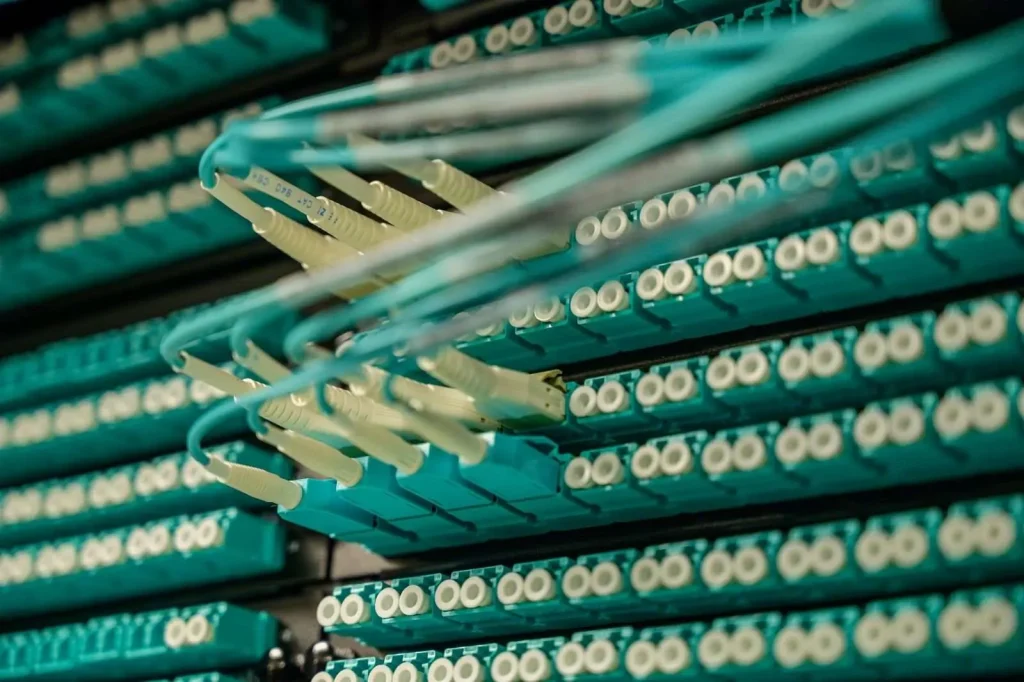
The numbers coming out of the technology sector this summer are hard to ignore. Industry researchers now expect the amount of data center capacity across the United States to roughly double before the end of the decade, driven almost entirely by the appetite of artificial intelligence. Every new model that writes, reasons, or answers a customer call has to live somewhere, and that somewhere is a growing constellation of power-hungry buildings that need to talk to one another at enormous speed. For most people the story stops at the shiny part: bigger chips, smarter assistants, faster answers. Doug Roberts, chief technology officer at Cytranet, spends his days thinking about the far less glamorous part that makes all of it actually work, which is the network in between.
“There is a tendency to picture artificial intelligence as something that happens inside a single powerful computer,” Roberts said. “In practice it is a conversation between a lot of computers in a lot of places, and that conversation only works if the connections between them are fast, dependable, and secure. When people talk about the data center boom, what they are really describing is a connectivity boom. The compute gets the headlines, but the network is what turns it into something a business can use.”
That distinction is more than a talking point for a regional provider like Cytranet, which delivers business internet, voice, unified communications, cloud, carrier services, managed services, and network security to companies, healthcare organizations, and government agencies across the Southwest. As the largest operators race to build out capacity, Roberts argues that the pressure quietly shifts downstream to everyone who depends on those networks to run payroll, take orders, coordinate field crews, or keep an emergency line answered. When the backbone of the internet is being rebuilt at this pace, the reliability of the on-ramp that a local business uses to reach it matters more, not less.
Why regional connectivity is having a moment
For years the assumption was that serious computing power lived far away, in a handful of enormous facilities, and that a business simply needed a decent connection to reach it. Roberts believes that model is changing in a way that plays to the strengths of regional providers. As artificial intelligence works its way into everyday tools, more processing is moving closer to where the work actually happens, a shift the industry describes as edge computing. A clinic that runs diagnostic software, a logistics firm that routes trucks in real time, or a county office that handles sensitive records increasingly wants that intelligence to respond in milliseconds rather than seconds, and that is only possible when the network path is short, redundant, and well managed.
“Latency is the quiet villain in most of these conversations,” Roberts said. “A customer does not care whether their data traveled two miles or two thousand. They care that the phone system answered instantly, that the file opened without spinning, and that the connection did not drop during the busiest hour of the day. Our job is to make the distance disappear. The exciting thing about this moment is that the technology finally rewards the kind of dense, local, carefully engineered network that a regional operator can build far better than a distant giant can.”
He points to the wider industry as evidence. Newer wireless standards are cutting response times meaningfully, fiber-first construction is being prioritized over patching aging equipment, and even the debate over whether satellites can replace ground-based infrastructure has, in his view, reinforced how much businesses value a physical connection they can count on. “There is a lot of enthusiasm right now for connectivity that comes from the sky,” Roberts said. “It has a real place, especially in remote areas. But for an organization that cannot afford to be offline, there is still no substitute for a well-built fiber route with a second path ready to take over the moment anything goes wrong. Redundancy is not glamorous, and it is exactly what keeps a business running.”
Building for demand that has not arrived yet
One of the harder parts of Roberts’ job is planning for growth that is difficult to predict. The same forces filling those new data centers are also changing how much bandwidth an ordinary business consumes, often without the business realizing it. Video meetings, cloud backups, security cameras, connected sensors, and now a steady stream of automated tools all share the same connection, and demand tends to arrive in waves rather than a smooth climb. Roberts describes the design philosophy at Cytranet as building headroom on purpose, so that a customer never notices the ceiling.
“The mistake is to size a network for what a company needs today,” he said. “We would rather engineer for the day two years from now when they have added a location, turned on a new application, and doubled their traffic without telling anyone, because that is what actually happens. The goal is for the network to feel boring. If our customers are thinking about their connection, something has gone wrong. If they never think about it, we have done our job.”
Security threads through all of it. As more of a company’s operations move onto the network and more automated systems make decisions in real time, the network becomes both more valuable and more of a target. Roberts is careful not to treat protection as a separate product bolted on at the end. He describes it as something woven into the way the network is built, monitored, and maintained, so that identifying unusual activity and isolating a problem is part of the everyday operation rather than an emergency response. For government and healthcare customers in particular, that steadiness is often the deciding factor.
A regional advantage in a national story
What comes through most clearly in a conversation with Roberts is that he sees the current wave of investment not as a threat that favors the largest players, but as an opening for providers who know their customers by name. The national story is about scale. The local story, he argues, is about fit, responsiveness, and trust, and those are qualities that a regional team can deliver in a way that a call center on the other side of the country cannot.
“The best part of this job is that a customer can call and reach someone who actually understands their setup,” Roberts said. “When the whole industry is being rebuilt around artificial intelligence, people want a partner who can explain what it means for them in plain language and then stand behind the connection that makes it possible. That is the role we intend to keep playing. The technology will keep changing. The promise of a network that simply works, and a team that answers when you need them, does not.”
For Roberts, that is the throughline connecting a national headline about doubling data center capacity to a single business owner in the Southwest wondering whether their connection can keep up. The answer, he believes, is that it can, provided the network underneath is designed with the same seriousness that the rest of the industry is finally bringing to the machines it connects. “This is one of the most interesting stretches I have seen in this field,” he said. “The demand is real, the technology is genuinely better, and the opportunity to give local organizations the same caliber of connectivity the giants enjoy has never been more within reach. That is a good place to be standing.”
Talk to Cytranet About Your Business Connectivity
Cytranet is a Las Vegas-based licensed telecommunications carrier providing dedicated fiber internet, fixed wireless, business VoIP and hosted PBX, managed Wi-Fi, colocation, and two-way radio solutions to businesses, nonprofits, and government organizations across Nevada, Arizona, California, and the broader Southwest. To discuss your needs with our team, call 702-846-5000 or email info@cytranet.com.
Talk to Cytranet
A business-only carrier for fiber internet, cloud voice, managed Wi-Fi, and managed IT. Start with a free technology evaluation.