
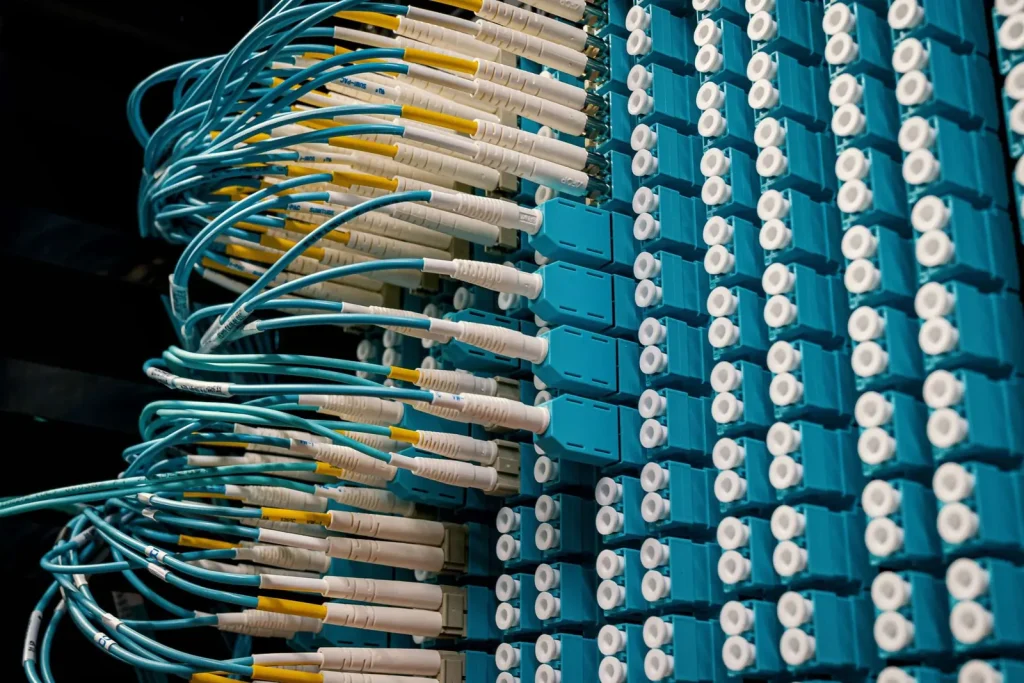
Fiber crews across the country are having their best year in a decade, but a lot of that new glass isn’t headed toward Main Street. It’s headed toward the enormous data center campuses being built to train and run artificial intelligence systems. Those projects need staggering amounts of dedicated, high-capacity fiber, and the construction crews, permitting priority, and even the raw materials to build it are increasingly being pulled toward wherever the next AI campus is going up.
That shift is starting to worry people who think about connectivity outside the biggest metro areas, and it’s a topic Doug Roberts, CTO of Las Vegas-based Cytranet, has been watching closely. Cytranet builds and operates fiber and network infrastructure for businesses, nonprofits, and government agencies in smaller markets across Nevada, Arizona, Utah, and California, including Henderson, Boulder City, and Pahrump in Nevada, Kingman and Lake Havasu City in Arizona, St. George and Cedar City in Utah, and communities across California’s High Desert, in addition to serving customers nationwide.
“There’s a real gravitational pull happening in this industry right now, and it’s pulling resources toward a handful of massive projects,” Roberts said. “That’s not a bad thing on its own. The country needs that computing capacity. But if you’re a regional provider, you start to notice that the same fiber contractors, the same conduit, the same skilled splicing technicians you’d normally book six weeks out are suddenly booked six months out, because they’re working an AI campus two states away.”
Why smaller markets can’t just wait their turn
The concern isn’t that regional fiber projects stop happening. It’s that they slow down at exactly the moment local demand is accelerating. Small and mid-sized businesses, school districts, medical clinics, and city and county government offices in smaller communities are adopting the same cloud-based tools, video collaboration platforms, and increasingly AI-assisted software that larger companies in big cities already rely on. That means their bandwidth and reliability expectations are rising just as fast as anywhere else, even if the size of the market is smaller.
“A twenty-person county office or a rural health clinic doesn’t need less reliability than a downtown high-rise. In some ways they need more, because they often don’t have a backup option if the connection drops,” Roberts said. “Our job is to make sure that build-out doesn’t get pushed to the back of the line just because the market is smaller and the headlines are somewhere else.”
Roberts said Cytranet has responded by locking in construction and equipment commitments further in advance than it used to, and by leaning on long-standing relationships with regional contractors rather than competing purely on price against national buyers with much deeper pockets. The company has also expanded its fiber footprint into a number of secondary markets over the past several years, arguing that being early to a smaller city is more valuable now than it was when capacity and labor were easy to come by everywhere.
Reliability is the product, not just the pitch
Cytranet’s core services, fiber-based business internet, voice and unified communications, managed WiFi, network security, cloud and data backup, and managed IT support, are aimed at giving smaller organizations the same caliber of network that large enterprises expect, according to Roberts. He said the AI-driven demand spike happening at the top of the market is, in an odd way, good validation for that approach, because it’s forcing the entire industry to think harder about capacity planning instead of treating bandwidth as an unlimited utility.
“For a long time the pitch was just ‘we’re fast,’” Roberts said. “Now the pitch has to be ‘we planned for this,’ because everyone’s usage curve is bending upward at once, whether that’s a business running everyday cloud applications or a government office rolling out new digital services. If you didn’t build in headroom, you’re going to feel it this year, not five years from now.”
He added that network security has to scale alongside capacity, not follow it. As more government agencies and businesses in smaller markets move sensitive operations onto connected systems, Cytranet has put more emphasis on proactive monitoring and layered security across its voice and data services, rather than treating security as an add-on.
Roberts is careful not to frame the current moment as a crisis. Rather, he described it as a test of whether regional infrastructure providers actually invested in the fundamentals during the quieter years, or simply rode along on excess capacity that used to be easy to find.
“The parts of the country that get left behind in the next few years won’t be the ones without any internet at all,” he said. “They’ll be the ones whose internet was never built to handle what’s coming. That’s the gap we’re trying to make sure our customers never fall into, whether they’re a ten-person office or a county government running critical services.”
As AI-driven demand continues to reshape how the telecom industry prioritizes construction and capacity, Cytranet says its focus remains on the markets that are easy to overlook, keeping smaller cities, local businesses, and public sector customers connected with the same reliability and security as anywhere else in the country.
Talk to Cytranet About Your Business Connectivity
Cytranet is a Las Vegas-based licensed telecommunications carrier providing dedicated fiber internet, fixed wireless, business VoIP and hosted PBX, managed Wi-Fi, colocation, and two-way radio solutions to businesses, nonprofits, and government organizations across Nevada, Arizona, California, and the broader Southwest. To discuss your needs with our team, call 702-846-5000 or email info@cytranet.com.
Talk to Cytranet
A business-only carrier for fiber internet, cloud voice, managed Wi-Fi, and managed IT. Start with a free technology evaluation.